
Levy County Sex Offender Checks
The Florida Sexual Offender and Predator System is the official starting point. FDLE says partner agencies transmit updates continuously. Search by a full or partial name when checking one person. For place-based awareness, leave the name fields blank and select Levy in the County field. That method reaches incorporated places and rural addresses that a Williston, Chiefland, Inglis, or ZIP-only query can miss.
No login or public-search fee is stated. The map distinguishes offenders, predators, and transient registrants. Results can be selected and printed to PDF in groups of no more than 25. A separate FDLE public data file offers county or statewide CSV data. Start broad, then narrow by identifiers, registered location, and status rather than relying on a name alone.
Levy Sheriff Registration Office
The Levy County Sheriff's Office is the county's in-person registration and compliance agency. Its campus is at 9150 NE 80th Avenue, Bronson, FL 32621. Call 352-486-5111 before visiting to confirm the proper unit and appointment procedure. Detention uses 352-486-5121. A qualifying person must report in person to the sheriff within 48 hours after establishing a permanent, temporary, or transient Florida residence or after a qualifying release.
A local jail registers a qualifying person within three business days after intake and again at release, then sends the data and digital photograph to FDLE. That chain explains why the state profile is the public view while the sheriff performs local checks. FDLE's bureau also answers registry questions at 1-888-357-7332 on weekdays from 9 a.m. to 5 p.m. Eastern.
Florida Registry Searches
FDLE publishes all qualifying sexual offenders, sexual predators, and qualifying juvenile sexual offenders. Florida does not hide a lower-risk tier from public view. The FDLE registry home gives access to search tools and supporting forms. The photographed registry screen below shows the official interface readers should recognize.
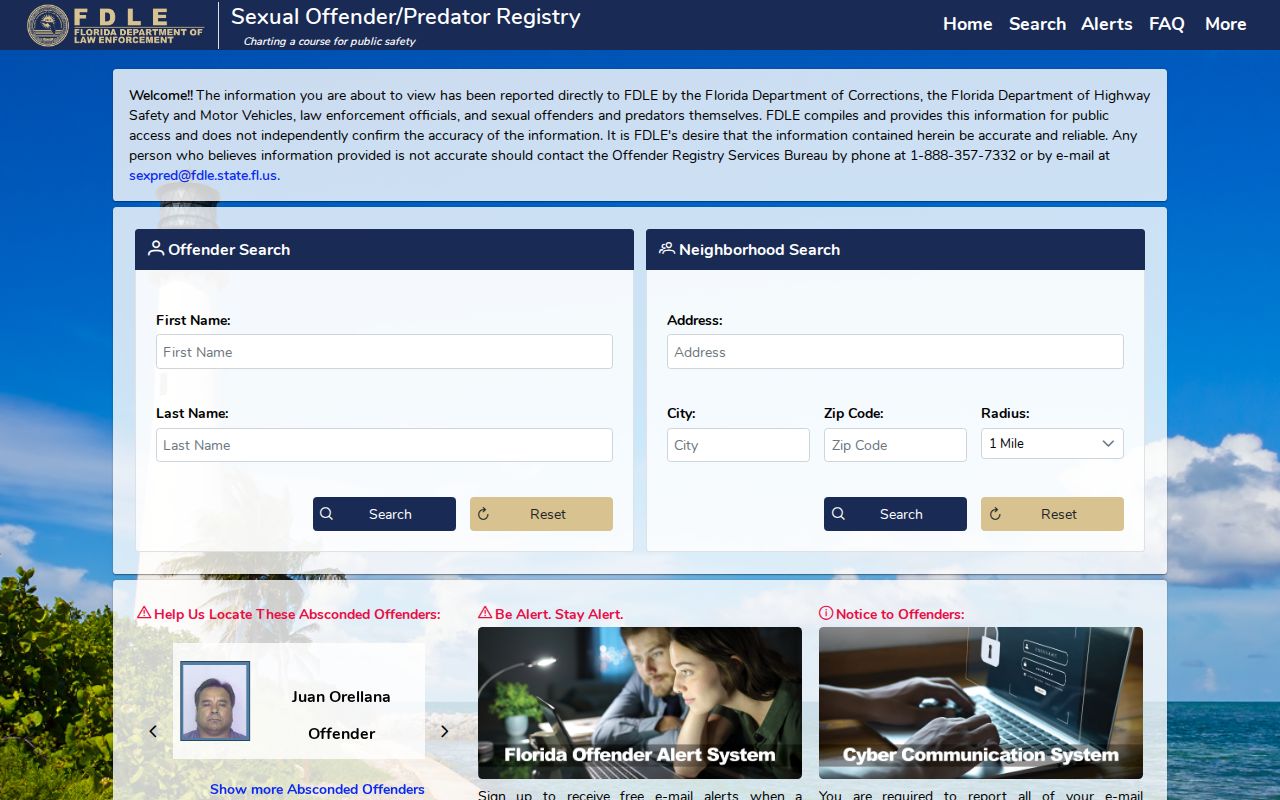
Use the system's own result list and flyer rather than a copied profile elsewhere. Follow this sequence:
- Open the FDLE detailed search and review its conditions.
- Enter a partial name or choose Levy County for a geographic list.
- Compare the photograph, designation, status, and location.
- Open the flyer, map, or Track Offender tool for more detail.
| Field Label | Type | Required | Notes |
|---|---|---|---|
| First or last name | Text | Conditional | Full or partial names accepted |
| City or ZIP | Text/select | Conditional | Returns geographic matches with names blank |
| County | Dropdown | Conditional | Select Levy for countywide coverage |
| Rows and selection | Controls | No | Shows 5 to 25 rows and selects records |
| Map and PDF | View/export | No | Maps status symbols; exports up to 25 records |
Levy County and National Results
FDLE is authoritative for a Florida registration. The National Sex Offender Public Website adds a cross-state layer by federating participating jurisdictions. Its screen is shown below. Use it when an address history or person may cross state lines, but return to FDLE for the current Florida profile and Track Offender link.
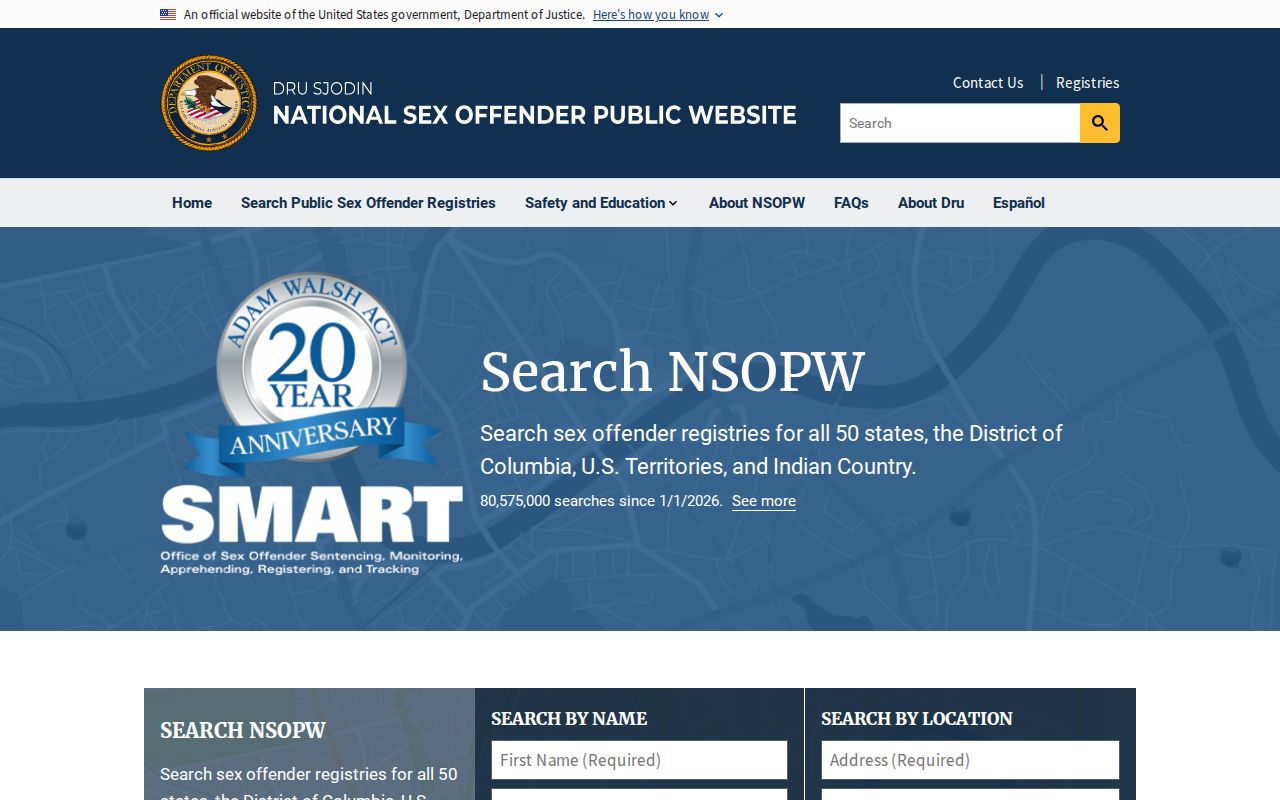
The two systems answer different scopes. NSOPW is useful for a national sweep. FDLE supplies the Florida designation, source agency, received date, status terms, flyer, county filter, and alert enrollment. Neither system substitutes for the clerk's underlying conviction file or an arresting agency report.
Registry Profiles: What They Show
The detailed FDLE registry search opens profiles built for identification and location awareness. The official screen image below helps distinguish that search from unofficial copies. Read the status and source date along with the address.
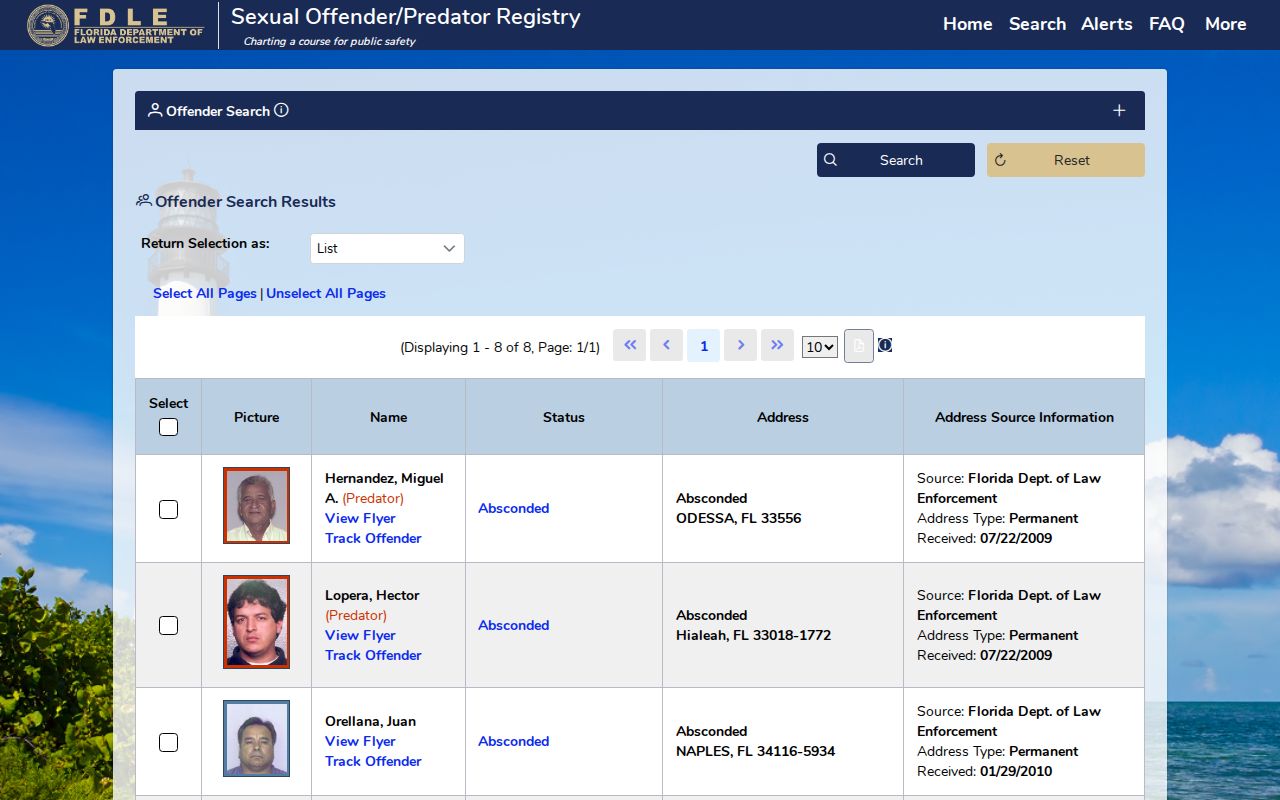
A flyer may show identity, descriptive, crime, and registered-location information. Some data collected for registration is broader than what every public flyer displays.
| Identity | Name, aliases, birth date, race, and sex when reported |
|---|---|
| Photo and description | Image, height, weight, hair, eyes, tattoos, and marks |
| Registered location | Permanent, temporary, or transient address type, city, and ZIP |
| Crime information | Brief crime, code or statute, conviction date and place |
| Designation | Sexual offender or court-designated sexual predator |
| Status and tools | Legal status, absconded or transient flags, flyer, map, and alerts |
Levy Offender Alert Options
Florida Offender Alert sends email when a registrant moves within a subscriber's chosen distance from a saved location. It can also track one registrant for moves anywhere in Florida. The FDLE result page's Track Offender link is the direct route for a person-specific alert.
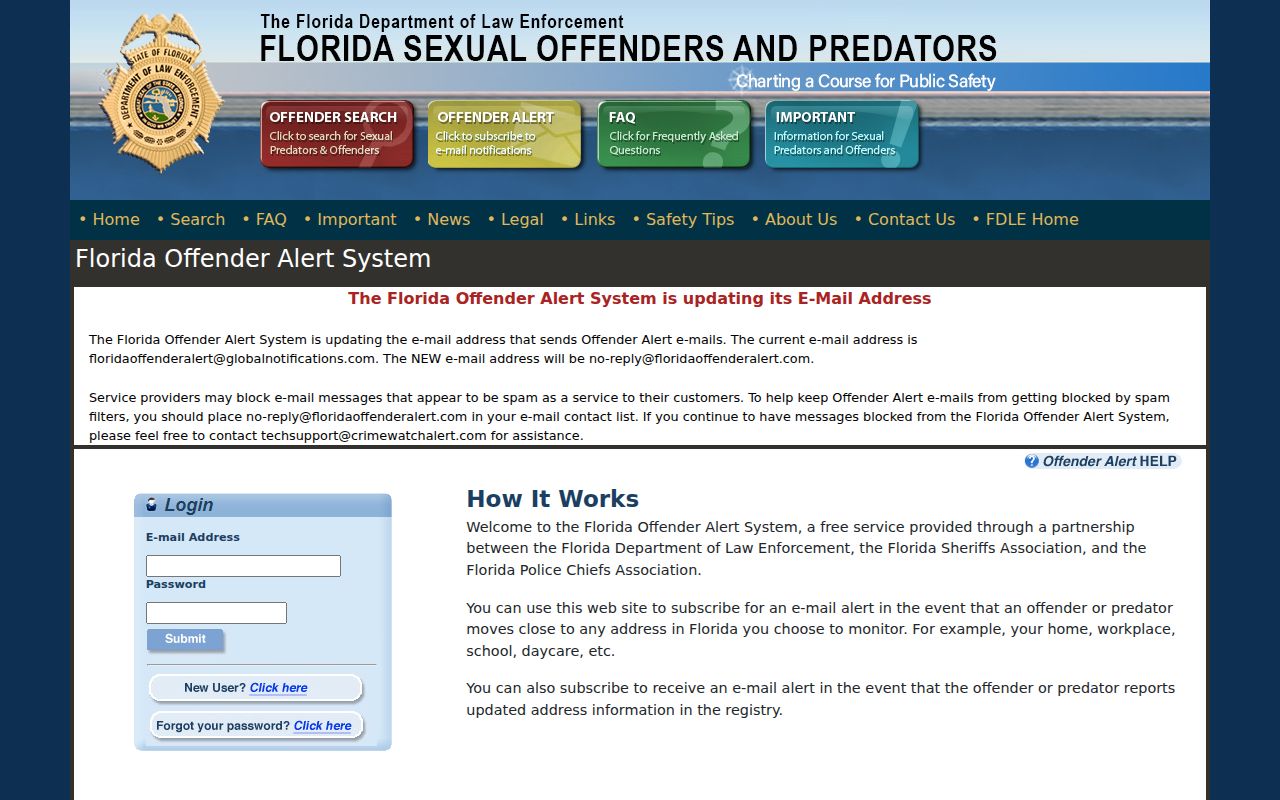
Alerts supplement, rather than freeze, a search. A Levy County resident can save a place for proximity notices and still rerun a county filter when reviewing a wider area. Email delivery is helpful for changes, but the current FDLE profile remains the record to check.
Registration Levels and Duties in Florida
Florida uses statutory designations, not public Tier I, II, and III risk rankings. Section 943.0435 governs sexual offenders, while section 775.21 governs court-designated sexual predators. Both qualifying groups are public. Frequency can vary with the conviction and designation, so a profile should not be assigned a federal tier label.
| Florida designation | Duration | Reporting |
|---|---|---|
| Sexual offender | Generally life, with a narrow petition route after at least 25 arrest-free years for eligible cases | Ordinarily birth month and the sixth month after it; some convictions require more |
| Sexual predator | Lifetime | Frequency follows the governing conviction and designation rules |
| Qualifying juvenile offender | Public when statutory age and offense criteria apply | As required by the applicable registration law |
| Out-of-state registrant | Florida lifetime framework applies after Florida residence is established | Florida reporting duties apply |
Florida Address Restrictions Explained
FDLE's FAQ says the statewide registration laws do not themselves create one blanket geographic residency ban. A separate law, section 794.065, limits residence within 1,000 feet of specified places for people convicted of certain offenses. Local ordinances or supervision conditions may add limits. A map point alone does not prove that an address is lawful or unlawful.
The official FDLE FAQ is the right source for these distinctions, and its page is pictured below. Check the governing conviction, supervision terms, local rule, and measured address facts before reaching a conclusion.
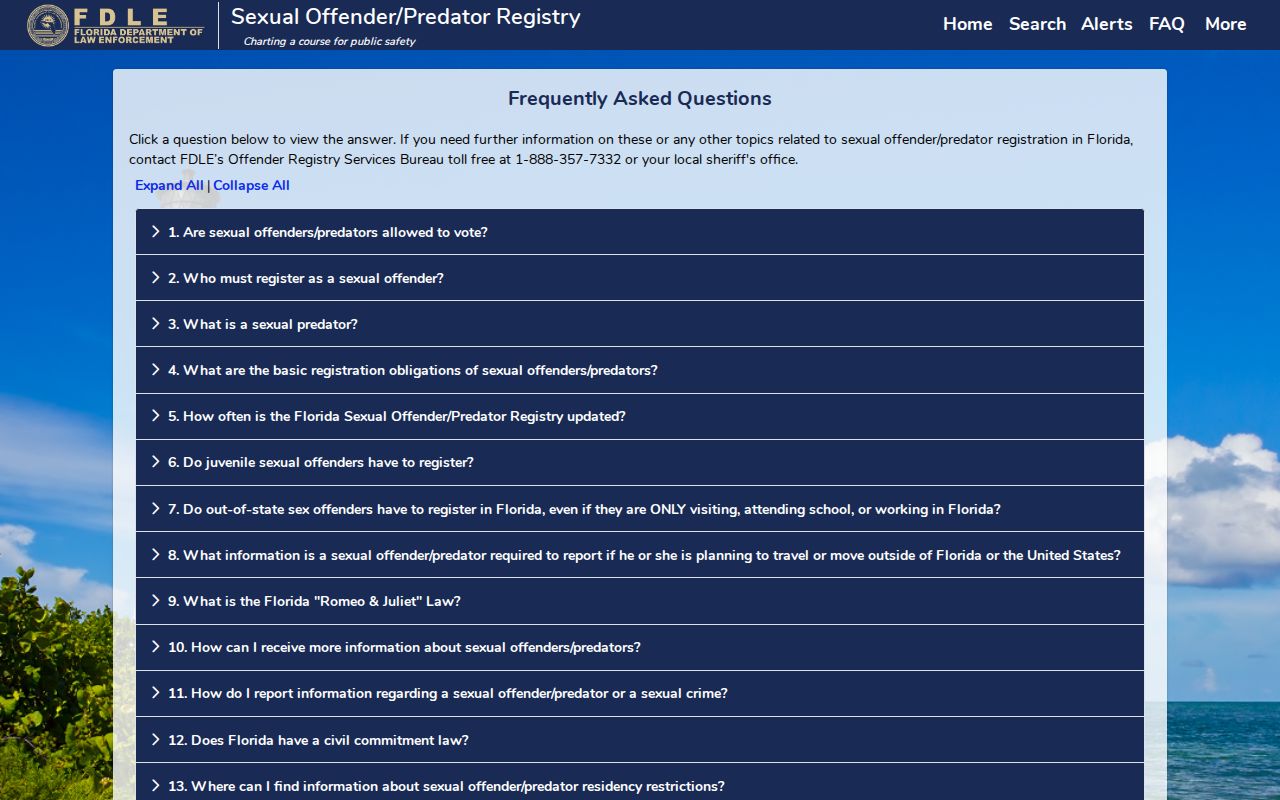
This nuance matters across rural Levy County, where postal place names and municipal borders do not always describe the same area.
Levy Compliance and Wrong Addresses
Report a suspected wrong address or registration failure to LCSO or the police agency with jurisdiction. Use 911 only for an emergency. FDLE asks the public to contact local law enforcement when a listed person is believed not to live at the registered address. Do not confront anyone.
LCSO has documented active compliance work. A June 2025 month-long initiative reported seven arrests and three continuing investigations. Operation: Holiday Sweep, announced December 19, 2025, reported seven registrants found out of compliance after checks by the ICAC/Sex Offender Unit and Patrol Division. Those summaries show enforcement activity, but they are not substitutes for profiles or court cases.
Using Registry Information Lawfully
Florida mandates community notification for a sexual predator. The sheriff or police chief selects an appropriate method and must notify licensed child-care facilities and elementary, middle, and high schools within one mile of the predator's residence. Notification for a sexual offender is authorized but not mandatory. The FDLE legal notice explains the limits, and the pictured official page should be read before using registry data.
The registry supports awareness and safety planning. For the full conviction record, use the clerk in the county of conviction. Levy County Clerk is at 355 South Court Street in Bronson and maintains felony, misdemeanor, and criminal-traffic records.
Misuse is a crime: Section 775.21(10)(d) penalizes specified misuse, false publication, or material alteration. Never threaten, harass, confront, or take vigilante action.