
Criminal Court Cases in Levy County
Levy County divides criminal work by charge level. The Eighth Judicial Circuit Court hears felonies. Levy County Court handles misdemeanors, criminal traffic cases, and ordinance matters. Both trial files are maintained by the Levy County Clerk of the Circuit Court and Comptroller at 355 South Court Street in Bronson. The clerk counter is open Monday through Friday from 8:00 a.m. to 5:00 p.m., and the main line is (352) 486-5266. Criminal traffic uses extension 1260; traffic uses extension 1247.
The clerk's circuit felony page describes how its office receives initial jail paperwork, assigns a number, and forwards arrest papers to the State Attorney. That source view appears below. It helps place the clerk between the booking event and the prosecutor's filing decision.
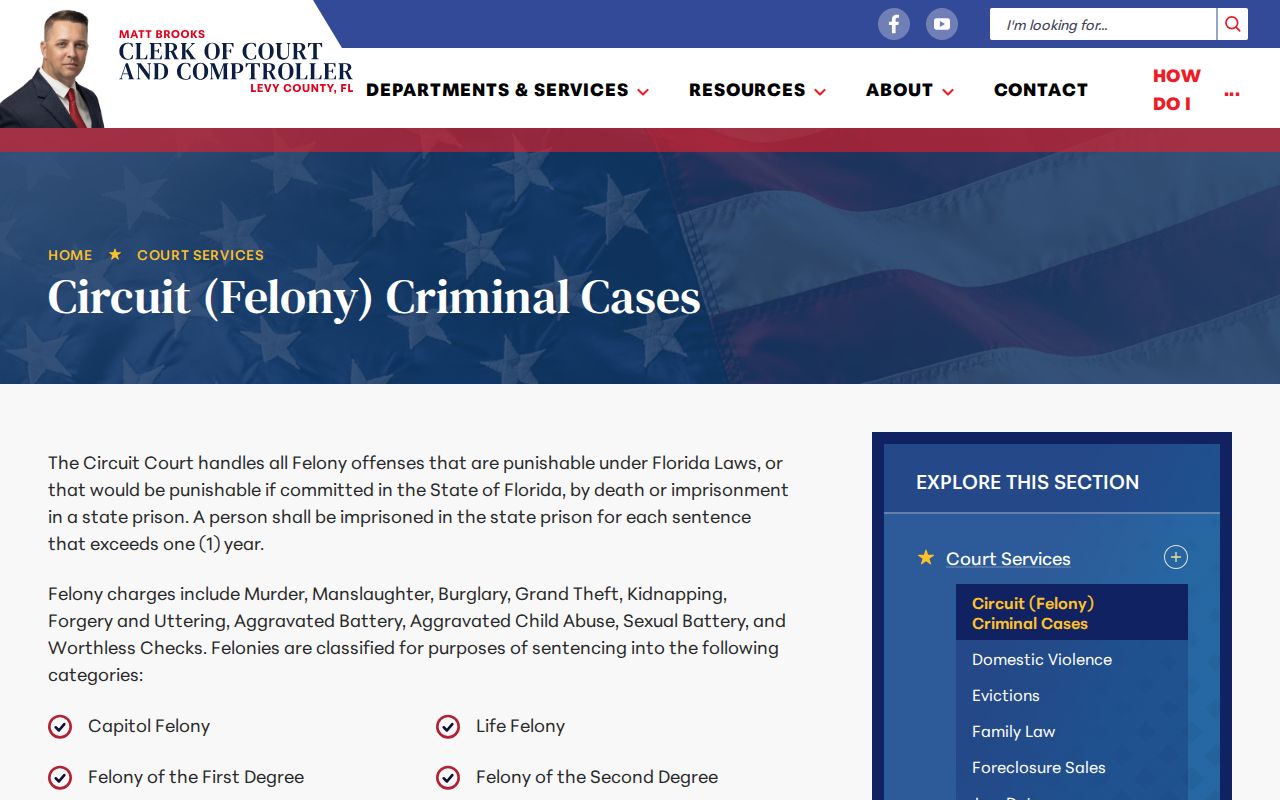
The image documents the official felony channel; it does not turn a booking allegation into a filed charge or final result.
Reading Levy County Criminal Case Numbers
A case number identifies the file more reliably than a name alone. An official Florida appellate example includes the originating Levy trial number 38-2022-CF-000430-A. In that format, 38 identifies Levy County and CF marks a circuit felony matter. The year, sequence, and party suffix narrow the record further. An appellate case receives its own appeal number, so readers should not treat the trial number and appeal number as the same identifier.
When the number is unknown, give the clerk the full name, aliases, an approximate filing or arrest date, and the kind of document sought. A date range and case type reduce false matches. Name-only results can combine people with similar names; a court file is case-centered, while an FDLE history is identity-centered and depends on arrest and disposition reports sent by agencies.
Levy County Case Record Searches
The Electronic Court & Records Access page is the official remote entry, but it is not an anonymous open search. A user must complete the Registration Agreement, scan it, email it to the clerk, and then accept the terms. The captured source below shows the access point that governs Levy County court case records.
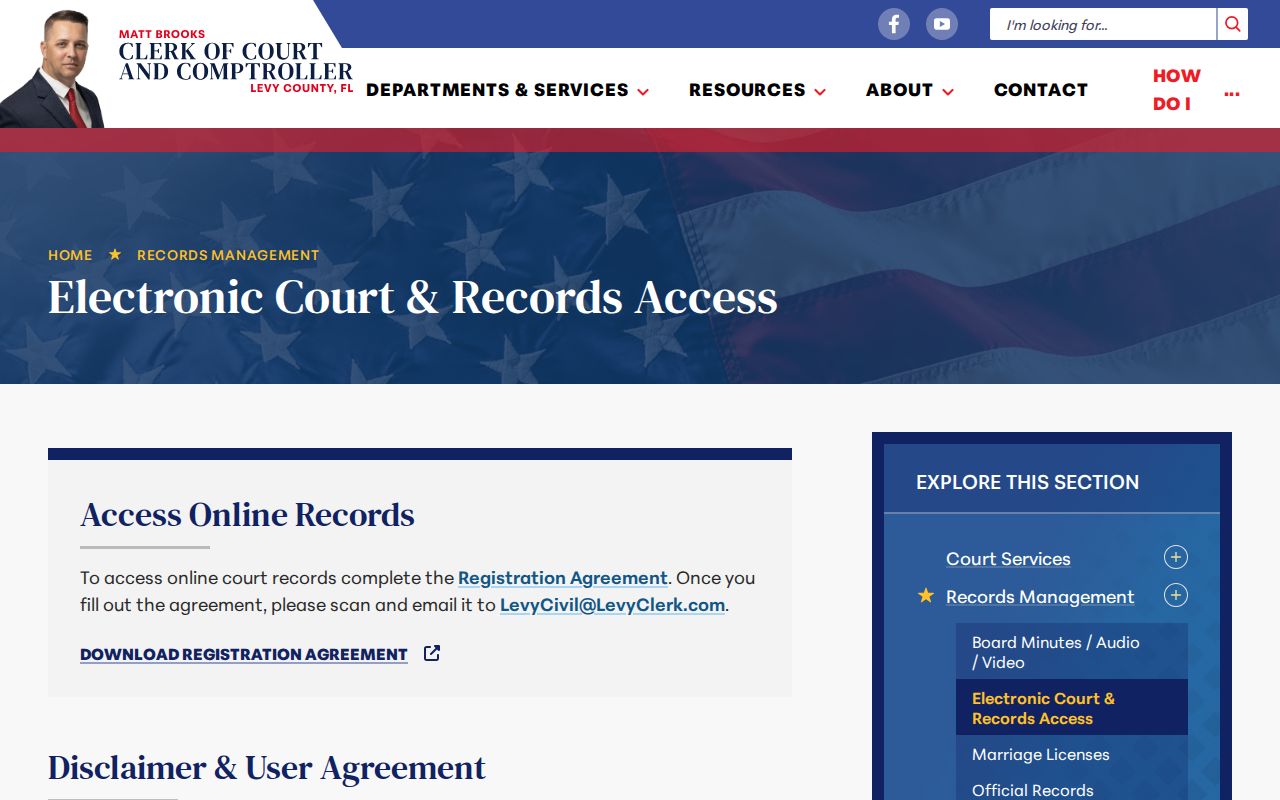
The registration gate means the public page does not reveal search fields or result limits. Do not assume it works like an open name-search portal.
- Start at the clerk's electronic access page and read the terms.
- Complete, scan, and email the required Registration Agreement.
- After approval, accept the terms and use a known case number when possible.
- Review docket entries, charge documents, pleas, orders, and disposition details.
- Ask the clerk for a paper, electronic, or certified copy when the screen view is not sufficient.
| Search detail | How to use it | Access note |
|---|---|---|
| Case number | Best key for one exact file | Use the complete Levy trial number |
| Name and aliases | Fallback when the number is unknown | Add an approximate date |
| Case type | Separate felony, misdemeanor, or traffic | Fields behind the gate are not publicly inventoried |
| Desired document | Name the information, order, judgment, or disposition | Useful for counter, mail, or email requests |
When Levy Court Files Are Offline
The clerk's felony information warns that criminal records are not online at this time, while the separate electronic-access page offers registered access. Read those statements together: remote access is limited and gated, and the clerk remains the fallback. Call (352) 486-5266, visit the courthouse counter, or submit a focused mail or email request. Court copies are listed at $1 per page. Ask about certification and any research cost before ordering.
The clerk public-records page supplies the request route shown here.
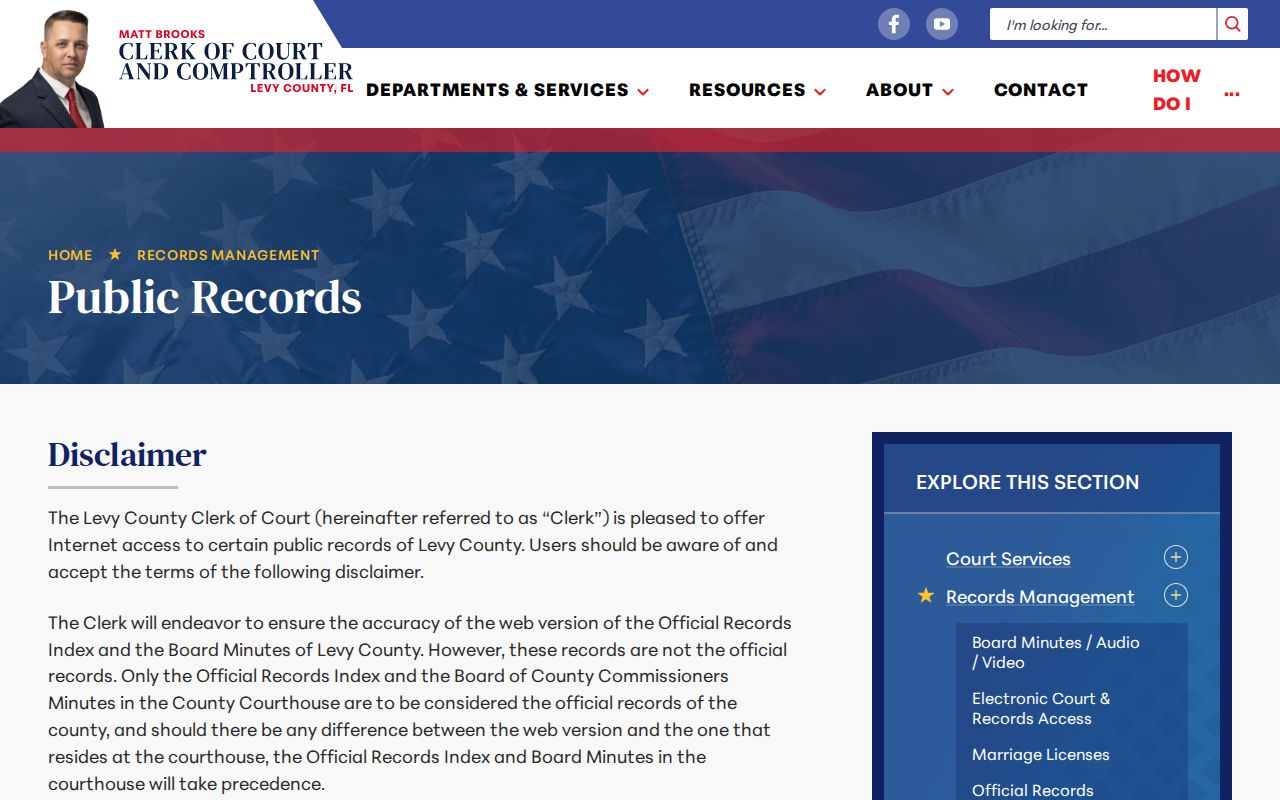
A narrow request should list the party, aliases, approximate year, known number, and exact items such as the information, docket, judgment, sentence, or certified disposition.
What a Criminal Case File Contains
A Levy County criminal case file tracks prosecution after papers reach the clerk. It may show a different charge from the arrest or booking record because the State Attorney independently decides what to file. The most useful item depends on the question. A docket gives the event sequence, while a certified disposition gives a clerk-authenticated outcome.
| Case Number & Court | Identifies the Levy file, division, year, and trial court. |
|---|---|
| Charging Document | An information filed by the prosecutor or an indictment returned by a grand jury. |
| Docket Entries | Dated filings, notices, motions, hearings, orders, and clerk activity. |
| Plea & Adjudication | The plea and whether guilt was adjudicated or formally withheld. |
| Disposition & Judgment | Outcome such as conviction, dismissal, acquittal, or nolle prosequi. |
| Sentence & Conditions | Custody, probation, community control, restitution, or other court terms. |
Note: Nolle prosequi means the prosecutor discontinued the charge; it is not another term for a conviction.
Levy Criminal Appeals in ACIS
Florida has no single public system that replaces county clerks for all trial cases. The Appellate Case Information System, or ACIS, covers the appellate layer. Its official portal is captured below. Use it when a Levy County criminal case moved to an appellate court, not as proof that the trial search has the same fields.
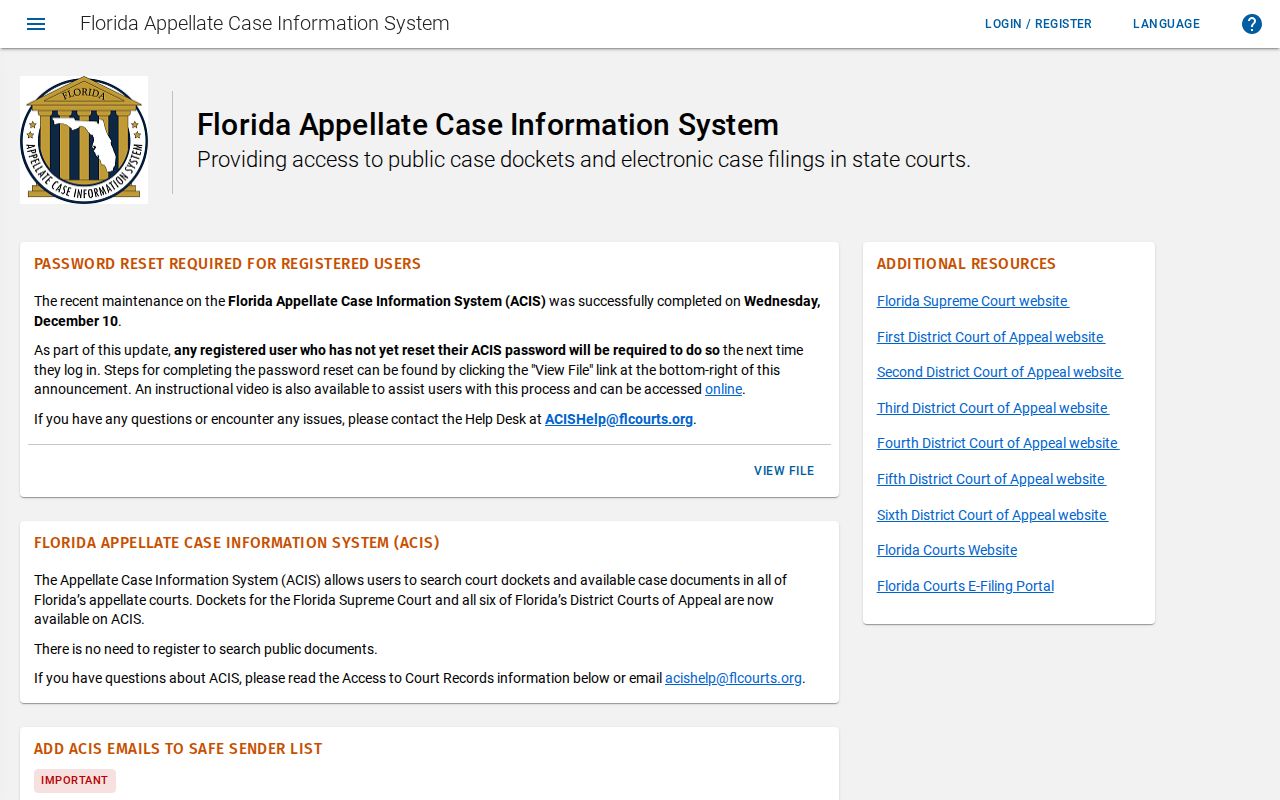
ACIS can show the appellate number, classification, docket date, originating court and trial number, status, parties, representation, oral-argument status, and a sortable docket.
An official Levy-origin appellate record demonstrates those fields.
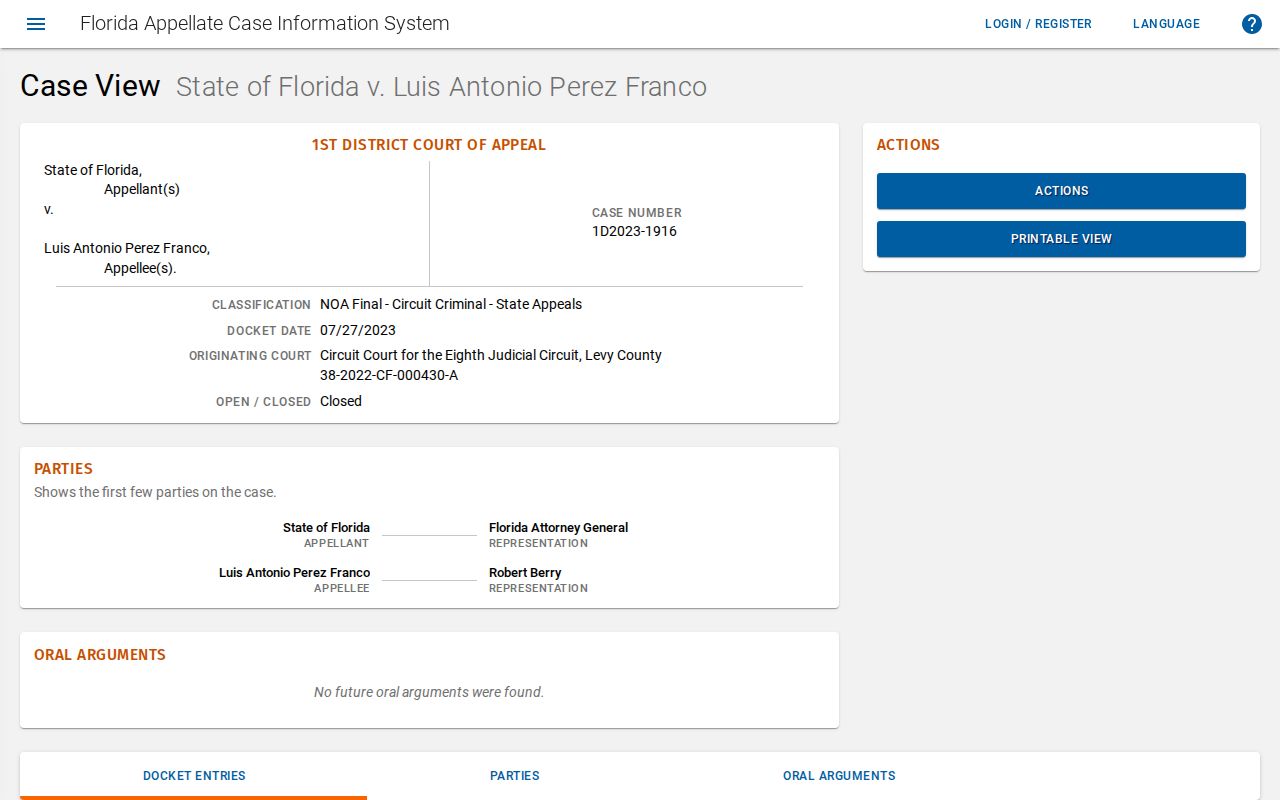
The sample connects the appellate docket to its Levy trial number, but the clerk remains the source for the complete trial file and certified trial disposition.
Criminal Case Stages in Levy County
After an arrest, jail papers reach the clerk. The clerk assigns the court number and sends copies to the State Attorney. The prosecutor may file an information, alter the alleged charges, or decline to proceed. At arraignment, the formal charge is presented and a plea may be entered. Case management and pretrial work follow. The matter may end by dismissal, plea, or trial, then move to disposition and any sentence.
Case flow: Charges Filed › Arraignment › Pretrial › Plea or Trial › Disposition › Sentencing
Notices go to counsel or, for an unrepresented defendant, by mail to the defendant and bondsman. A change of address must be filed in writing. Missing a required felony appearance can lead to a capias, which is a court command for arrest, plus bond forfeiture and possibly a higher bond or no bond.
Certified Levy County Criminal Dispositions
A screen print is informational and nonofficial. A certified disposition carries the clerk's authentication and is the better record when the exact court outcome matters. It is also required in Florida's sealing or expunction certificate process for each target case or charge. Ask for the final disposition, judgment, and sentence if those items are separate.
Check the name, case number, charge, plea, adjudication, disposition date, and sentence before leaving the counter or accepting a mailed copy. If an FDLE history lacks the final outcome, use the certified Levy County disposition when asking the reporting agency or FDLE to review the mismatch. The clerk file and FDLE record serve different roles, so a correction in one system may not instantly update the other.
Access Rules for Case Records
Florida Constitution article I, section 24 and Florida Public Records Law favor access, while Florida Rule of General Practice and Judicial Administration 2.420 governs court-record confidentiality. Public views may omit Social Security numbers, account data, protected victim information, confidential juvenile material, and records sealed or expunged by law. A missing online result does not prove that no case exists.
Registered electronic access is described as informational, nonofficial, and noncertified. The clerk says data normally updates daily except weekends and holidays, without a guarantee, and notes Sunday maintenance for the civil search. For a criminal case that cannot be found, contact the clerk and give enough detail to distinguish it. Ask which rule or exemption supports any withheld portion.
Why Levy Criminal Records Differ
The jail record proves that detention intake occurred. The clerk file shows what was prosecuted and how the court acted. FDLE assembles statewide arrest cycles and reported outcomes around identity data. Reporting lag, a name mismatch, or a missing disposition can cause the three sources to disagree. Fingerprints, not a shared name, establish positive identity.
Start with the source closest to the fact in question. Ask Detention about booking and release, the clerk about filed charges and judgments, and FDLE about the statewide history. Readers tracing a booking into court can use the county's arrest search channels, then match the resulting case number at the clerk. This sequence avoids treating an initial allegation as the final court result.