
Chiefland Criminal History Checks
Use the city police contact for an incident or arrest report created by CPD. Move to LCSO for county booking status and to the Levy Clerk for a criminal or traffic docket. This sequence separates an officer's account from custody data and the prosecutor's filed charge.
A practical search runs in five steps:
- Confirm that the event was inside Chiefland and CPD responded.
- Call CPD with the report number, date, location, and desired material.
- Use LCSO detention channels when the event produced a booking.
- Search the Levy Clerk for county or circuit court filings.
- Use FDLE only when a broader Florida history is needed.
Records may appear at different times. A police report can exist before a booking, and a booking can exist before a clerk case number.
Reports at Chiefland Police
Chiefland Police Department is at 14 E. Park Avenue, Chiefland, FL 32626. The official FDLE police directory lists 352-493-6777 and fax 352-493-6776. Call the police number to ask whether a report exists, what portion is public, and which delivery methods are available. The city does not publish a dedicated police-report request form, public arrest blotter, or police case portal.
Give the incident or report number if known, along with the date, place, involved agency, requested portions, and delivery preference. Do not add sensitive personal data that staff does not need to identify the file. Broad requests can take more review because exempt investigative or victim details may need redaction.
Records at Chiefland Police
CPD is the right custodian only when it created the record. A Chiefland mailing address can sit outside municipal limits, and LCSO may respond in the surrounding area. State officers may also handle a crash, warrant, or investigation. Read the agency name on a citation, report receipt, or booking entry before filing a Chapter 119 request.
City police material can include an incident number, date and location, responding personnel, alleged offense, narrative, property or evidence references, and arrest details, subject to exemptions. It does not show the final court result. Use the county docket for charges, pleas, orders, and disposition.
Chiefland City Records Custodian
City Hall and the public-records custodian are at 214 East Park Avenue, Chiefland, FL 32626. The city lists 352-493-6711 and fax 352-493-6714. This address differs from CPD at 14 E. Park Avenue, a small but important distinction. Send police-specific requests to CPD first and use the city custodian when departmental ownership is unclear or the record is administrative.
The official City of Chiefland home page shows the city contact point and is pictured below.
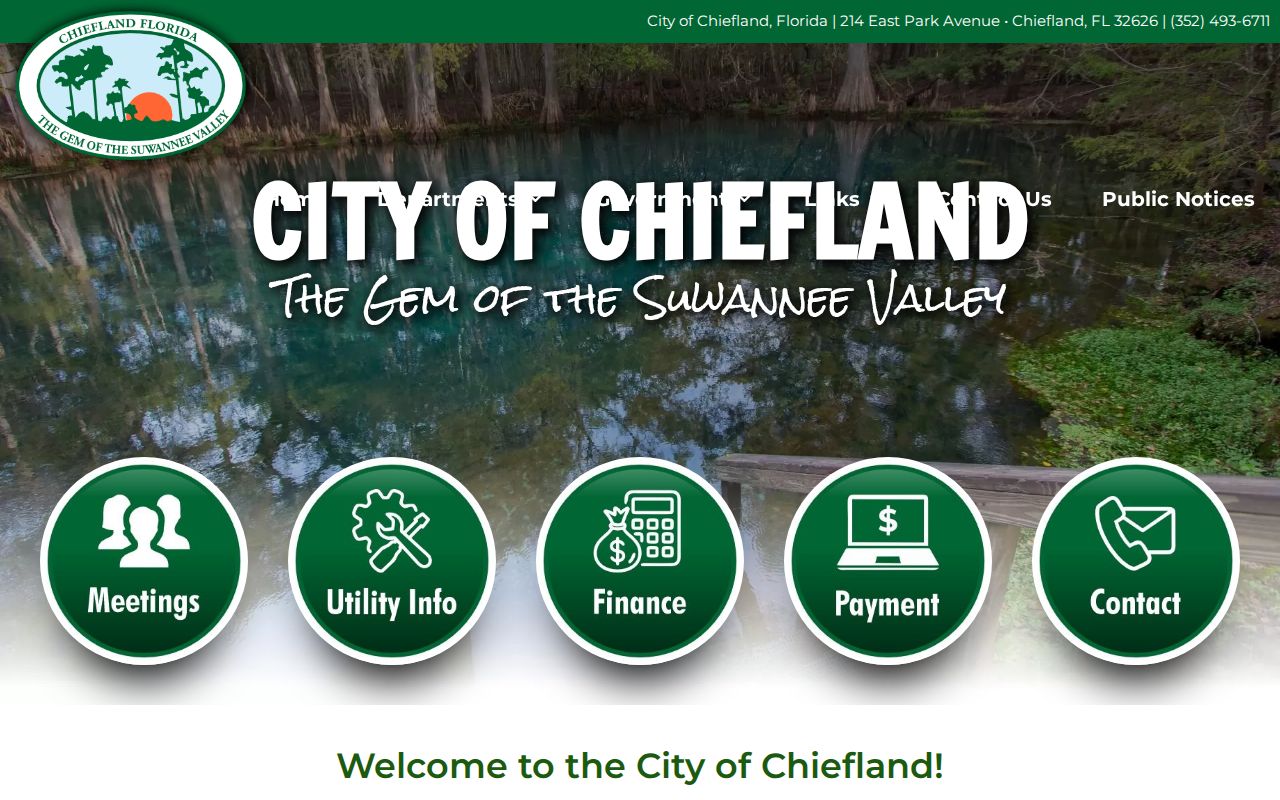
The city site is a routing source, not a criminal case database. Describe the creator and subject of the record so staff can direct it without guesswork.
Booking and Arrest Records in Chiefland
When CPD makes an arrest and the person enters county custody, the Levy County Detention Bureau creates the booking record. Call 352-486-5121 or use the official Jail Tracker. Check CPD for the agency report and the Clerk for a later court file. Chiefland has no public police blotter or separate city jail roster documented in official sources.
The three records are not interchangeable. A CPD report states the investigation and initial allegation. The detention record answers custody, bond, and release questions. The Clerk docket shows what prosecutors filed and what the court did. A booking is not proof of guilt.
Following Chiefland Arrests to Court
A recent arrest may not yet have a court number. Search again after charging papers reach the Clerk, or call 352-486-5266. Use a case number from release documents when possible. Name searches can return similar people, so compare the date, charge, and court level.
The Levy County court case lookup explains the docket in more depth. Certified copies and the official case file come from the Levy Clerk, not CPD or a web screenshot. The filed offense can differ from the initial arrest label.
The Chiefland Municipal Court File
Chiefland has no municipal court. Florida's 1972 Article V reform consolidated local trial courts, and current Rule 2.265 treats old references to municipal courts as county courts. A city ordinance case, misdemeanor, or criminal traffic event goes to Levy County Court. A felony goes to circuit court.
| Expected city court | No Chiefland municipal court or city case portal exists |
|---|---|
| Ordinances and misdemeanors | Levy County Court |
| Felonies | Florida Circuit Court, Eighth Judicial Circuit |
| Lookup channel | Levy Clerk Electronic Court & Records Access |
| File contents | Filed charges, hearings, pleas, orders, disposition, and sentence when public |
The heading preserves the city-court topic while the facts correct a common assumption. Do not search Chiefland City Hall for a criminal docket.
Chiefland U.S. 19/98 Traffic Records
Chiefland's position on U.S. 19/98 makes the Levy Clerk traffic department a key records route. It handles all county citations, provides civil-infraction choices and court dates, and directs criminal-traffic questions to 352-486-5266 extension 1260. Confirm whether the citation was written in Levy County and read the agency and court details printed on it.
The Levy Clerk traffic department is the official source, shown in the image below.
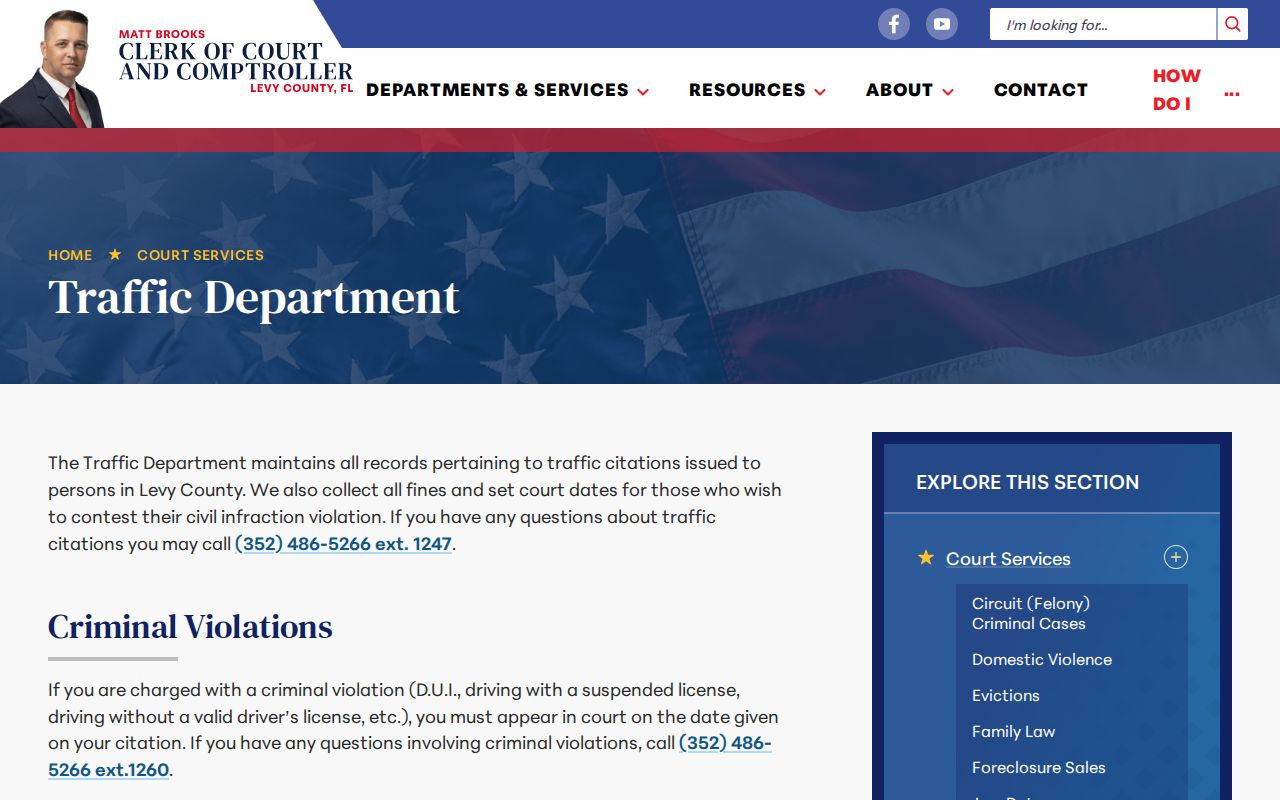
A criminal traffic file is a court record. The police citation may start it, but the Clerk maintains the docket and court date.
Faxing Chiefland Record Requests
CPD and City Hall publish different fax numbers. Use 352-493-6776 for the police department and 352-493-6714 for the city custodian. Put the intended department, record type, report number or date range, and desired delivery method on the inquiry. Keep a transmission confirmation.
Fax is an alternate request channel, not a special route around exemptions or fees. Ask the recipient to confirm that the request reached the proper custodian. If LCSO created the incident or the Clerk holds the desired docket, sending it to Chiefland can only add routing time.
How Chiefland Records Reach the County
CPD creates its report and transmits arrest information through the justice system. LCSO separately records a county booking. The Clerk opens a file when charging documents arrive. Reported arrest cycles and dispositions can later enter FDLE's statewide repository, where timing or identity issues may create temporary gaps.
Record flow: Chiefland Police Department › Levy County Courts › Florida Department of Law Enforcement
For a recent event, start near the beginning. For the actual prosecution and result, move to the Clerk. For statewide self-review, use the official FDLE channel.
Chiefland's Western Levy Role
Chiefland describes itself as a North Central Florida southern community and serves as a commercial center for western Levy County. That role draws traffic from rural areas whose postal labels do not always match city boundaries. A place described as “Chiefland” can therefore involve CPD, LCSO, or another agency.
The Chiefland city manager and custodian page identifies the public-records contact and is shown below.
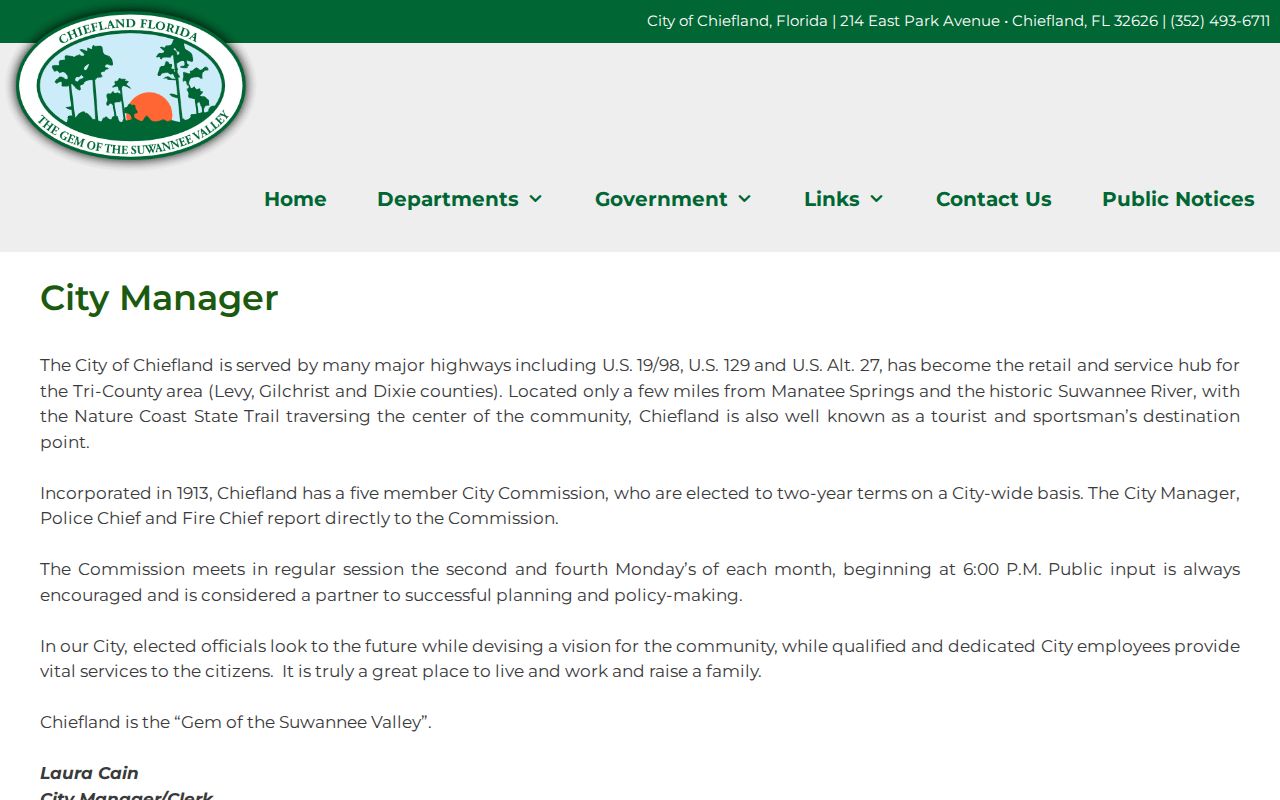
Always pair the place name with the exact incident location and responding agency. This one check prevents many requests from going to the wrong counter. Keep the CPD report number, detention booking identifier, and Clerk case number separately because the three systems do not use one universal key.
CPD Reports Versus Court Dockets
A Chiefland police report records the agency's work near the start of an event. It may state witness accounts, evidence, alleged offenses, and the officer's basis for action. A court docket begins later and records the charge prosecutors filed, hearings, pleas, motions, orders, and disposition. The two can use different offense labels without either record being the wrong person's file.
Read chronology first. An arrest allegation may be amended or dismissed. A release from booking says nothing by itself about the final case. If a recent docket is missing, use the arrest date and report identifier when asking the Clerk whether papers have arrived. If the report itself has a factual error, contact CPD, since the Clerk cannot change another agency's source record.
For a self-review, keep copies of both source records and note the date each was obtained. A later Clerk entry may resolve an open status shown on an earlier printout. When the statewide record lacks that outcome, the certified court disposition is the best document to gather before contacting FDLE about its repository entry.
Chiefland Request Details That Help
Because no dedicated CPD web form publishes required fields, a concise request should supply only facts that locate the incident. Include the date or short date range, precise place, report number, responding department, and the parts sought. State whether inspection, paper copies, or an electronic file is preferred. A fax cover sheet should clearly distinguish police from City Hall.
Ask for a cost estimate if the scope may require long video review or extensive redaction. If staff says CPD did not create the file, request the name of the likely custodian rather than broadening the same city request. This is especially useful near city limits, where a Chiefland postal address may describe an LCSO response.
Chiefland Record Access Rules
Chapter 119 and Florida's constitutional access right generally open agency records, but statutory exemptions protect specified active investigations, juvenile matters, victim information, medical details, and security data. The custodian can redact protected material and release the rest. Court files may also be confidential, sealed, expunged, or limited by order.
Key laws:
Florida Statutes section 119.07 provides the general inspection and copying right subject to exemptions.
Florida Statutes section 119.071 protects listed agency and personal information.
Florida Statutes section 943.0585 governs court-ordered expunction of eligible records.
Ask for the public portion and the legal basis for any withholding. A denied detail does not always make the full Chiefland record confidential.